
Motivational Interviewing (MI) Overview
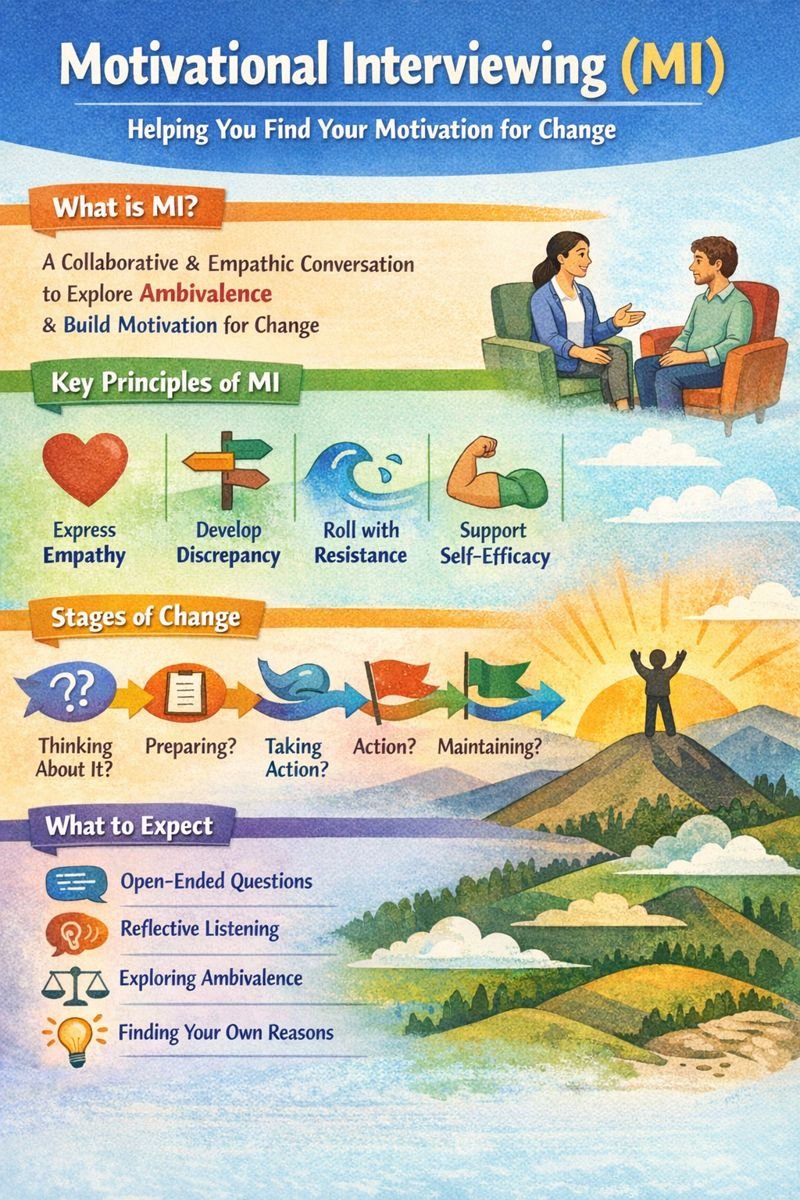
What Is Motivational Interviewing (MI)?
Motivational Interviewing is a collaborative, person-centered style of conversation used in therapy to help individuals explore and resolve ambivalence about change and strengthen their own motivation and commitment to change. It was developed by William R. Miller and Stephen Rollnick in the 1980s and has been widely used in addiction treatment, health behavior change, and many therapeutic settings. Motivational Interviewing+1
MI is not about directing or pushing a client toward change. Instead, it focuses on drawing out the client’s own reasons and desire for change — honoring their autonomy and readiness. Motivational Interviewing
A simple definition from experts:
A collaborative, goal-oriented style of communication with a focus on the language of change — designed to increase a person’s own motivation and commitment to change. Motivational Interviewing
The “Spirit” of MI
MI is more than techniques — it’s an attitude or way of being with a client. The core qualities include:
Collaboration
Therapist and client work together as partners rather than expert vs. recipient. Motivational Interviewing
Evocation
The therapist helps draw out the client’s own motivations and reasons for change, rather than telling them what to do. Motivational Interviewing
Autonomy
The client’s freedom to choose and make decisions is honored — change is something the client chooses, not something imposed. Motivational Interviewing
Acceptance and Compassion
MI is respectful and empathetic, focusing on understanding the client’s perspective without judgment. Paramount Recovery Centers
This spirit builds trust and a safe space for open exploration. Motivational Interviewing
Why MI Is Helpful
Many people experience ambivalence — wanting change and also wanting to stay the same. MI helps make sense of that conflict by:
Exploring both sides of the ambivalence
Increasing insight into personal reasons for and against change
Increasing confidence that change is possible and worth trying Motivational Interviewing+1
MI is especially effective when a person isn’t sure what they want to do yet — helping them move from uncertainty toward clarity and action. Psychology Today
What Happens in MI Sessions
In a typical MI-informed session, you might experience the following:
Open-Ended Questions
Rather than yes/no questions, therapists ask questions that help you reflect — e.g., “What concerns you most about this behavior?” Human Services
Reflective Listening
The therapist listens deeply and mirrors back what you say to help clarify meaning and emotion. Psychology Today
Affirmations
The therapist may highlight your strengths and past successes to boost confidence. hazeldenbettyford.org
Exploring Ambivalence
Instead of fighting resistance, the therapist explores it with you — understanding why change feels hard and meaningful. Brown Health
Change Talk
The therapist helps you articulate your goals, reasons, and commitment to change in your own words — reinforcing motivation from within. Case Western Reserve University
Core Principles of MI
MI is often guided by four foundational principles:
Express Empathy — Understand your experience without judgment. Case Western Reserve University
Develop Discrepancy — Help you see the difference between your current situation and where you want to be. Brown Health
Roll with Resistance — Respect hesitation rather than pushing against it. Case Western Reserve University
Support Self-Efficacy — Strengthen your belief that change is possible. Case Western Reserve University
These principles support a warm, respectful, non-confrontational partnership. Psychology Today
Stages You Might Recognize
Through MI conversations, you might explore where you are in the change process — from not considering change to planning and acting on it. MI helps meet you where you are without pressure. Wikipedia
What Clients Often Experience
Clients commonly report:
Feeling heard and understood
Reduced defensiveness
Clearer personal reasons for change
Increased confidence in making changes
A sense of ownership over goals and decisions Psychology Today
Helpful Website Resources
Here are reputable resources clients can explore:
Core MI Information
Motivational Interviewing Network of Trainers – What MI Is
https://motivationalinterviewing.org/understanding-motivational-interviewing Motivational Interviewing
Client-Friendly Overviews
Psychology Today — Motivational Interviewing Explained
https://www.psychologytoday.com/us/therapy-types/motivational-interviewing Psychology TodayUC Davis Human Services Overview of MI
https://humanservices.ucdavis.edu/blog/motivational-interviewing-overview Human Services
Techniques & Principles
Positive Psychology MI Summary and Skills
https://positivepsychology.com/motivational-interviewing/ PositivePsychology.com
MI Research & Broader Uses
Wikipedia Summary of Motivational Interviewing (MI)
https://en.wikipedia.org/wiki/Motivational_interviewing Wikipedia
In Summary
Motivational Interviewing is a respectful, supportive, and collaborative conversation style designed to help you find your own motivation and reasons for change. Rather than telling you what to do, MI helps you discover what matters most to you and how you might move forward.
