
Ketamine-Assisted Psychotherapy (KAP)
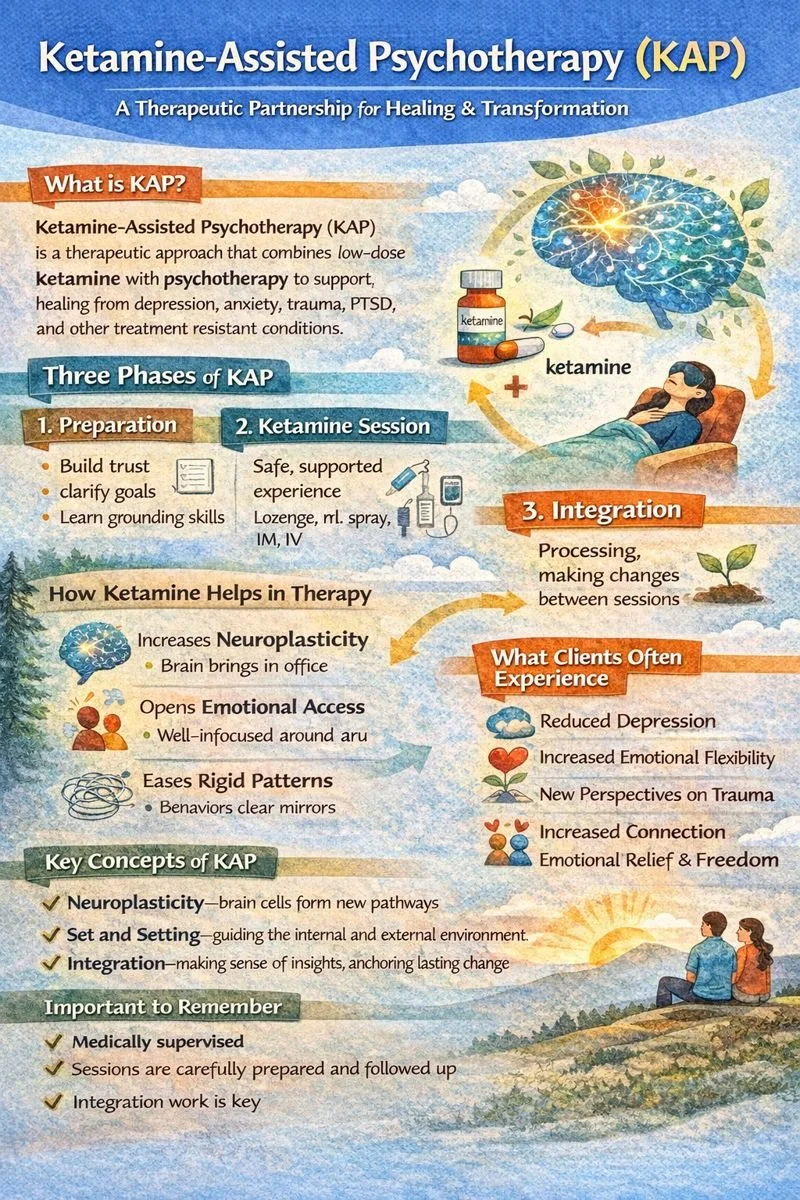
What Is Ketamine-Assisted Psychotherapy (KAP)?
Ketamine-Assisted Psychotherapy (KAP) — is a therapeutic approach that combines low-dose ketamine with psychotherapy to support healing from depression, anxiety, trauma, PTSD, and other treatment-resistant conditions.
Ketamine is a medication that has been safely used in medical settings for decades. In KAT, it is used at carefully controlled, sub-anesthetic doses to help create a mental state where change, insight, and emotional processing become more accessible.
🧠 How Ketamine Helps in Psychotherapy
Ketamine works differently than traditional antidepressants. Rather than taking weeks to build up, ketamine can:
Increase neuroplasticity (the brain’s ability to form new connections)
Temporarily reduce rigid or negative thought patterns
Decrease emotional avoidance and defensiveness
Create a sense of psychological distance from painful memories or beliefs
This allows therapy to go deeper and faster, especially when someone has felt “stuck” despite prior treatment.
🔄 The Three Phases of Ketamine-Assisted Psychotherapy
🧩 1. Preparation
Before any ketamine session, therapy focuses on:
Building trust and safety
Reviewing medical and psychological readiness
Clarifying goals and intentions
Learning grounding and integration skills
Preparation is essential—it helps ensure the experience is meaningful and emotionally safe.
🌊 2. The Ketamine Session
During the dosing session:
Ketamine is administered (commonly via lozenge, nasal spray, IM injection, or IV—depending on provider and setting)
You may experience altered perception, deep introspection, emotional openness, or vivid imagery
The therapist provides a supportive, non-directive presence
You remain conscious and able to communicate
Experiences vary widely and are not about forcing insight, but allowing what arises to unfold naturally.
🌱 3. Integration
Integration is where lasting change happens. In follow-up sessions, therapy focuses on:
Making sense of insights or emotional experiences
Translating awareness into concrete life changes
Strengthening new perspectives and coping strategies
Anchoring growth into daily life
Without integration, ketamine experiences tend to be short-lived. With integration, they become transformative.
🧘 What Clients Often Experience
Clients commonly report:
Reduced depressive symptoms
Increased emotional flexibility
New perspectives on trauma or long-held beliefs
A stronger sense of connection (to self, others, or meaning)
Relief from rumination and emotional numbness
Not every session is dramatic—sometimes subtle shifts accumulate over time.
⚠️ What KAP Is (and Is Not)
KAP is not:
A recreational or “escape” experience
A stand-alone medication fix
A replacement for ongoing therapy or personal work
KAP is:
A therapeutic catalyst
A collaborative medical-psychological treatment
Most effective when combined with structured psychotherapy
🕒 What to Expect Practically
Treatment usually involves a series of sessions, not just one
Sessions are medically monitored
You’ll need time to rest after dosing sessions
You should not drive the same day
Commitment to preparation and integration significantly improves outcomes
🧠 Who May Benefit Most
KAP has shown promise for individuals experiencing:
Treatment-resistant depression
PTSD and complex trauma
Anxiety disorders
Existential distress
Burnout or emotional rigidity
Substance use recovery support (in appropriate settings)
Medical screening is always required to ensure safety.
🌐 Trusted Educational Resources
📘 Foundational Information
MAPS – Psychedelic-Assisted Therapy Overview
https://maps.orgNational Institute of Mental Health – Ketamine & Depression
https://www.nimh.nih.gov
🧠 Clinical & Client-Friendly Resources
Journey Clinical – Ketamine-Assisted Psychotherapy
https://www.journeyclinical.comPsychology Today – Ketamine-Assisted Therapy Explained
https://www.psychologytoday.com/us/therapy-types/ketamine-assisted-therapy
📚 Research & Education
Yale School of Medicine – Ketamine Research Program
https://medicine.yale.edu/psychiatry/research/programs/clinical_people/depression/ketamine/
🎥 Introductory Videos
Search YouTube: “Ketamine-Assisted Psychotherapy Overview”
(clinical explainers by psychiatrists and licensed therapists)
✨ In Summary
Ketamine-Assisted Therapy is a powerful, evidence-supported approach that helps loosen rigid patterns, enhance emotional access, and accelerate therapeutic progress. When paired with skilled preparation and integration, it can open doors that once felt firmly closed.
