
Family Systems Therapy Overview
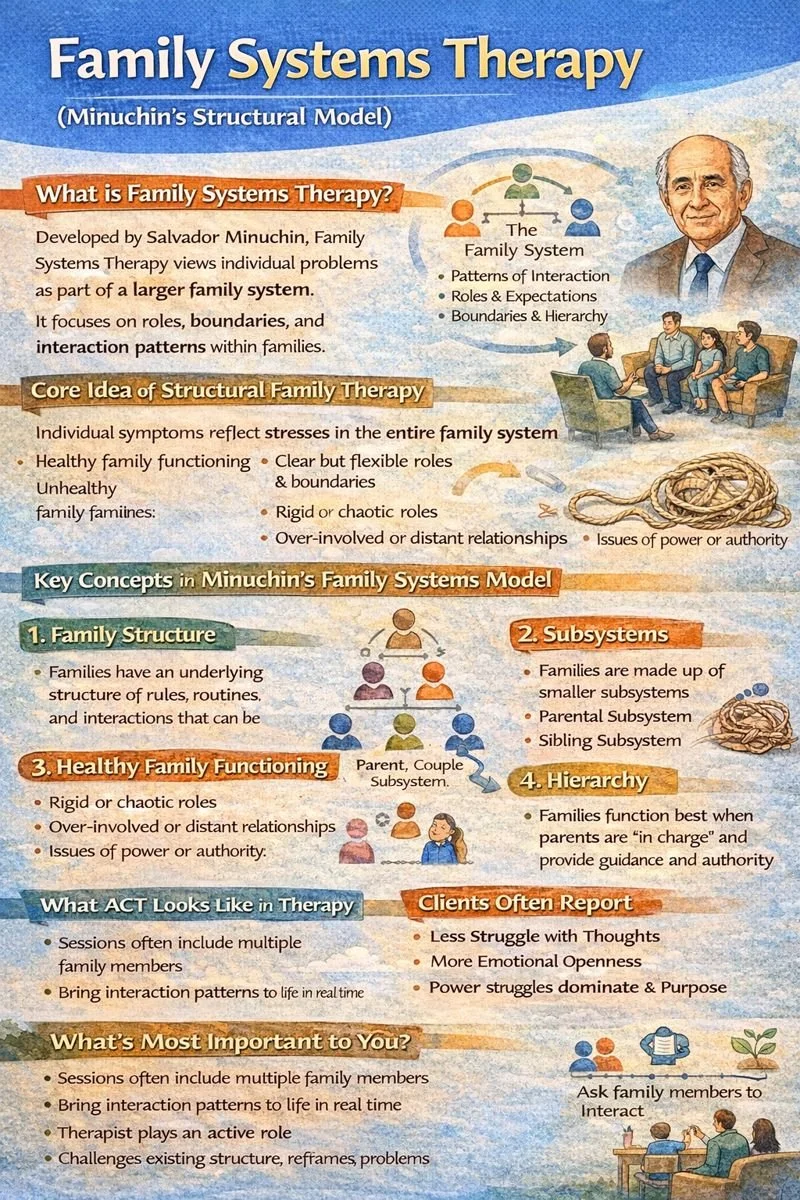
What Is Family Systems Therapy (Minuchin’s Structural Model)?
Structural Family Therapy (SFT) is a form of family systems therapy developed by Salvador Minuchin. It focuses on how family relationships, roles, boundaries, and interaction patterns shape individual behavior and emotional well-being.
Rather than viewing problems as belonging to one person, this approach understands distress as emerging from the structure of the family system — how family members relate, communicate, and respond to one another.
Core Idea of Structural Family Therapy
Minuchin believed that:
People are best understood in the context of their family relationships, not in isolation.
Symptoms (such as anxiety, depression, behavioral issues, or conflict) are often seen as signals that the family system needs adjustment, not as evidence that someone is “the problem.”
Key Concepts in Minuchin’s Family Systems Model
1. Family Structure
Every family has an underlying structure that includes:
Rules (spoken or unspoken)
Roles
Patterns of interaction
Healthy structures are flexible and adaptive. Rigid or chaotic structures often lead to distress.
2. Subsystems
Families are made up of smaller subsystems, such as:
Parental subsystem
Couple subsystem
Sibling subsystem
Each subsystem has specific roles and responsibilities. Problems arise when boundaries between subsystems become unclear or unhealthy.
3. Boundaries
Boundaries define how emotionally close or distant family members are.
Clear boundaries → healthy balance of connection and independence
Enmeshed boundaries → overly involved, little independence
Disengaged boundaries → emotionally distant, disconnected
Therapy often focuses on strengthening, loosening, or clarifying boundaries.
4. Hierarchy
Healthy families have a clear and appropriate hierarchy, especially between parents and children.
Issues can arise when:
Children take on adult roles
Parents lose authority
Power struggles dominate relationships
Structural therapy works to restore functional leadership and balance.
5. Patterns & Transactions
Therapists observe repetitive interaction patterns, such as:
Escalating conflicts
Triangulation (pulling a third person into conflict)
Alliances that undermine other relationships
Change happens by altering these patterns, not just talking about them.
What Happens in Structural Family Therapy
Sessions are often active and experiential. The therapist may:
Observe real-time family interactions
Ask family members to talk to each other directly
Reframe problems to reduce blame
Coach new ways of interacting
Strengthen parental leadership
Interrupt unhelpful patterns as they occur
The therapist takes an active, directive role, helping the family practice healthier interactions in session.
What Clients Often Experience
Families often report:
Improved communication
Clearer roles and expectations
Reduced conflict and blame
Stronger parental leadership
Healthier boundaries
Better emotional safety and connection
Change is often felt relationally, not just internally.
Who This Approach Is Helpful For
Minuchin’s family systems model is especially helpful for:
Parent–child conflict
Adolescent behavioral concerns
Blended family challenges
Divorce or co-parenting difficulties
Trauma impacting family functioning
Eating disorders (a major focus of Minuchin’s early work)
Families feeling “stuck” in repeating conflict cycles
What to Expect Practically
Sessions may include multiple family members
Therapy focuses on the present, not just the past
Change often begins with small shifts in interaction
Progress is measured by improved family functioning, not perfection
Helpful Resources
Minuchin Center for the Family
https://www.minuchincenter.orgPsychology Today – Family Systems Therapy Overview
https://www.psychologytoday.com/us/therapy-types/family-systems-therapyStructural Family Therapy (overview articles & diagrams)
https://www.goodtherapy.org/learn-about-therapy/types/structural-family-therapy
In Summary
Minuchin’s Family Systems Therapy helps families:
Understand how relationships shape behavior
Reduce blame and increase collaboration
Strengthen boundaries and leadership
Create healthier, more flexible family patterns
The focus is not on who is wrong, but on how the system can change to support everyone better.
